Albert Brooks manages to hit just about every nerve in 2030.
There are no hovering cars, much to the dismay of sci-fi fans
everywhere — but there are plenty of familiar things, and they've all
gone awry.
Matthew Bernstein is the first Jewish
president of the United States of America. He is faced with a nation in
dire straits: the number of "retirees" is growing unabated, now that
many of the diseases that used to kill people are things of the past.
The cost of doing business continues to skyrocket, but the number of
people contributing is decreasing.
The "American dream"
of having a better, more successful life is a distant memory. Brooks
introduces us to a few of the players in 2030, including the President,
his wife — and a surprising new relationship the President never saw
coming. We meet members of every generation — which, now that people
have sufficient health to permit them to live comfortably into the
triple digits.
What is a little scary is the way these
characters are living our future. Brad is healthy and financially
solvent into his 80s, though the same can't be said of all of his
friends. Kathy will never attend college because the financial burdens
on her family are too great. Shen Li has created a modern, efficient
and amazing medical future for people in even the most remote areas —
and something that will prove to be profitable in this country.
Brooks'
strength is envisioning a future that does not include hovercraft and
jumpsuits. He doesn't go too far, just far enough. The questions he
answers are ones that are hot topics today: aging, federal entitlement
programs, the cost of college, the power of the AARP, health care and
health insurance, whether the U.S. Constitution should be updated to
reflect the mores of the here-and-now, national debt and borrowing from
other countries — and whether California will slip into the ocean when
"the big one" comes.
Find this book, read it and see where we very well could wind up — and what Los Angeles will smell like in 2030.
Sunday, July 29, 2012
Friday, July 27, 2012
Wednesday, July 25, 2012
Woman Feeding Chickens
Her hand is at the feedbag at her waist,
sunk to the wrist in the rustling grain
that nuzzles her fingertips when laced
around a sifting handful. It's like rain,
like cupping water in your hand, she thinks,
the cracks between the fingers like a sieve,
except that less escapes you through the chinks
when handling grain. She likes to feel it give
beneath her hand's slow plummet, and the smell,
so rich a fragrance she has never quite
got used to it, under the seeming spell
of the charm of the commonplace. The white
hens bunch and strut, heads cocked, with tilted eyes,
till her hand sweeps out and the small grain flies.
sunk to the wrist in the rustling grain
that nuzzles her fingertips when laced
around a sifting handful. It's like rain,
like cupping water in your hand, she thinks,
the cracks between the fingers like a sieve,
except that less escapes you through the chinks
when handling grain. She likes to feel it give
beneath her hand's slow plummet, and the smell,
so rich a fragrance she has never quite
got used to it, under the seeming spell
of the charm of the commonplace. The white
hens bunch and strut, heads cocked, with tilted eyes,
till her hand sweeps out and the small grain flies.
by Roy Scheele
from A Far Allegiance
© The Backwaters Press, 2010.
Courtesy The Writer's Almanac
Tuesday, July 24, 2012
Releasing Books into the Wild
I buy books for a few reasons. Sometimes I want to read the books, and other times I want to share them with my bookish friends.Occasionally I duplicate what's in my library, and those books are given to friends and the Lunchroom Lending Library at work.
Then there are the books I purchase because they sound too delicious to pass up and, frankly, someone needs to read them.
My friend Carole is a trouper, reading quite a few titles in the last category. She was unfortunate enough to read part of Plague Dogs, a book that was so gut-wrenching I not only asked her to stop reading it, but to return the book so I could recycle it. (That is the only book I have doomed to that fate, and I'm not sorry.) On the flip side, she read The Heroines, a novel in which an owner of a bed and breakfast encounters the heroines of English literature. I can't wait to read it!
With used bookstores and thrift stores in my path, I find many books that simply need to be shared. After a while, even Carole has to reign me in. So, what is a reader to do?
I was told about BookCrossing by a fellow reader at last year's Fall for the Book Festival. BookCrossing takes book-sharing to a new level: readers give books individual codes when they share them so fellow readers with access to the Internet can chart the book's movement when they encounter them. Sure, it requires people to play along, but it costs nothing. (Okay, I purchased stickers for the books, but I could have done it for nothing.)
Here's the cool part: you put them in places where people will find them and take them home to read. (That's called "releasing them into the wild.") You also can give a book to a friend (a "controlled release").
I thought it was a lovely idea, in theory. Then I went to my local Potbelly Sandwich Shop without a book, and discovered the shop had a bookcase. I borrowed a book — and decided I needed to pay back the book deities who placed a book in my path when I needed it.
Last week, I took a handful of books, coded them and sprinkled them around the area. A few went to the gyms at the nearby university, others went to the library "free book" box, and even more wound up at the pool around the corner. I put one at the community center. I think David still has one for his gym.
I am excited.
Have you tried BookCrossing? Did you like it? Have you ever found a BookCrossing book? (I did once and left it in its natural habitat for a reader to find.) Tell me!
Friday, July 20, 2012
Wise Words: The Lorax
Without a doubt, The Lorax is one of my favorite literary characters. So I share his (and Dr. Seuss') wise words.
Can you do that? I know I'll try.
Wednesday, July 18, 2012
In Honor of E.B. White's Centennial: Rapping Elements
Only a love of language and grammar could bring English teachers to create a rap song about The Elements of Style.
How can you not chuckle at lyrics " Write for the New Yorker, papers marked up in scarlet / I spin webs with words like my name was Charlotte"? (Wait, does the question mark go inside the quotation marks? See what this does to me?)
Without further ado, and to save what's left of my sanity, I give you rapping E.B. White and William J. Strunk, Jr., the authors of The Elements of Style.
The Elements of Style from Jake Heller on Vimeo.
The lyrics are pure poetry:
My name is Strunk
And they call me White
Here to teach you how to put the pen down right
I see that your writing is a little bit wild
These are the Elements of Style.Will Strunk in the house but don’t call me junior
Grammatical genius. Number one word groomer.
I teach English 8 at the school of Cornell
Choose your words carefully or I’ll put you through hell.E.B. White on the mic, former student of Strunk
A story that flows is all I need to get crunk
Write for the New Yorker, papers marked up in scarlet
I spin webs with words like my name was Charlotte.“In the last analysis”
That’s a bankrupt expression
It’s clear you’re not learning
So listen to my lesson.
Omit needless words. Good writing is concise
When I was in your class, you repeated that thrice
9 times out of 10 ‘student body’ is wrong
Say students instead. Move your story right along.My name is Strunk
And they call me White
Here to teach you how to put the pen down right
I see that your writing is a little bit wildThese are the Elements of Style.Split infinitive
Never definitive
Sounds unintelligent
Dumb and inelegant.
Just say it like you meant
Always write with intent
Each word precious
Like Benjamins that you spent.Do not join independent clauses with a comma.
But I love it, it’s cool.
I don’t care if you wanna.Jails and schools should not be called facilities.
I hate all these writers with second-rate abilities.
Don’t use dialect ‘less your ear be good
You cover East Harlem, but you ain’t from the hood.Be clear brief bold with each story told
If it’s your goal to turn ink to gold.My name is Strunk
And they call me White
Now you know how to put the pen down right
When I read your work, you know I’m gonna smile
Those were the Elements of Style.
Friday, July 13, 2012
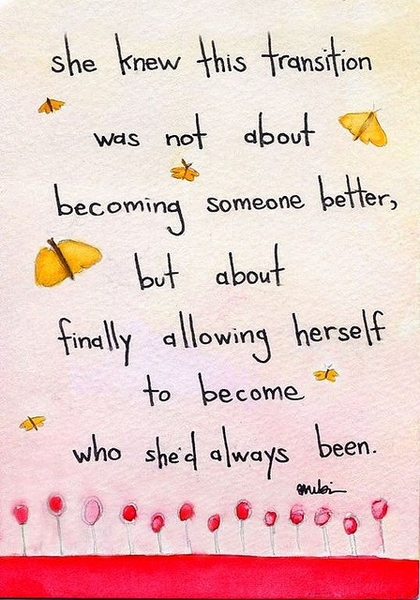
Wise Words: On Becoming
Who you are is better than anyone else you may become. Enjoy being you, and the rest of us will, too.
Subscribe to:
Posts (Atom)